If you were alarmed by the recent news that Tylenol could contribute to the onset of autism, it’s best to keep that feeling of being alarmed and use it as a moment of some sort of awakening.
For the truth is that too many ingredients and drugs that government(s), doctors, FDA, and many comforting scientists describe as absolutely safe, are in reality, unsafe.
(BTW, not entirely sure whether Tylenol causes autism, per se; but I’m 100% sure that Tylenol is not entirely safe to take as a pregnant woman. I would like to say that this much is common sense if you just look into what Tylenol is MEANT to do, but it looks like such common sense is highly lacking among scientists and doctors.)
It is crucial to employ doubt and reasoning not only for personal development, but for SURVIVAL these days. Once health and well being are lost by your trust in false assurances by authorities, no one can reverse it… take care.
I think most users of FreshCult are likely rather unusual people with this regard: they are probably equipped with what I’d call intelligent common sense. They already rejected the prevalent narrative of the society, that goes something like this:
“It’s a conspiracy theory that x, y, z are not safe.”
“It’s being debunked by scientists already.”
“It’s been approved by the FDA, so it’s perfectly safe.”
I’m gonna make a series of posts on individual ingredients that are SAID TO BE SAFE but are not safe, so that these arsenals of knowledge can further aid us in our search for safety and freedom.
Here’s the first one: propylene glycol.
Propylene glycol is one of very prevalent deodorant and antiperspirant ingredients. In natural deodorants as well.
For instance, Tom’s of Maine lists propylene glycol as the first ingredient for its aluminum-free deodorant on its website. Take a look.
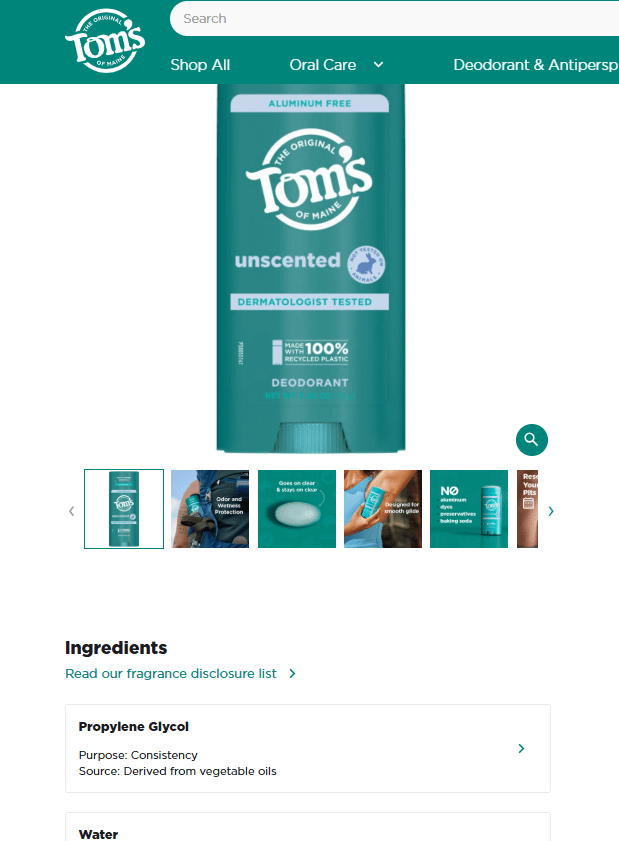
Tom’s of Maine says the purpose of propylene glycol is consistency, and the source is vegetable oils.
It’s what makes solid sticks and gel deodorants glide. It gives a nice skin feel. But I should share some research on how it made mice lose brain cells and spread cancer.
The first research paper that I had read a while ago on the potential danger of propylene glycol was on how it killed neurons in mice:

Basically, the paper showed in animals that injection of propylene glycol led to excessive apoptosis–self-killing–of developing mouse brain cells. Neurons, when they are killed, regenerate less well and less often than other cells. So losing neurons is pretty bad. But because this paper used quite high amount of propylene glycol, I looked for studies that used more physiological conditions.
And that is how I encountered a UCSF study from 2024: propylene glycol (!!!), not nicotine, may be why vaping is so bad for cancer.
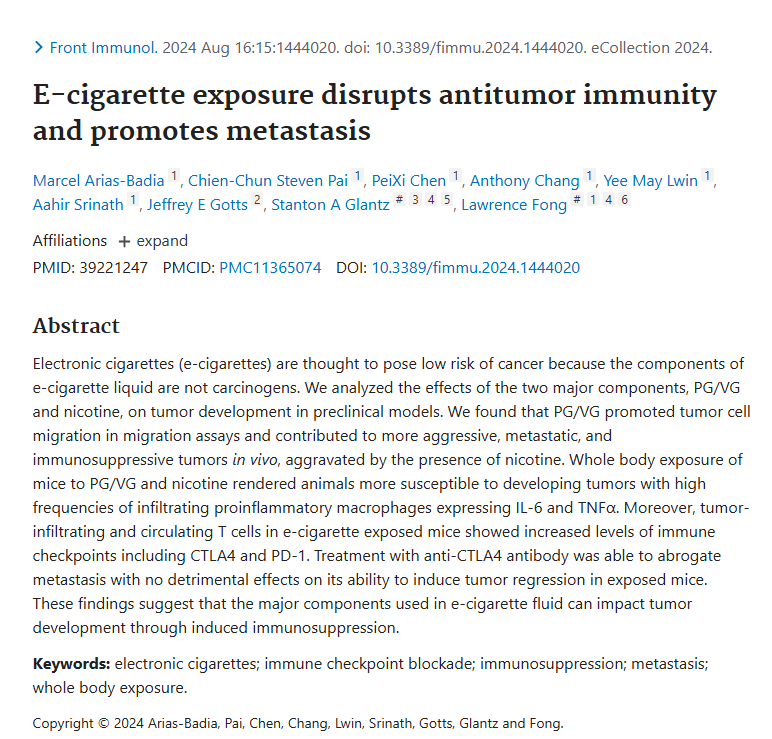

They made a smoking chamber, where they let mice inhale the smoke from e-cigarette. In mice that were not inhaled (black bar), cancer cell spread (metastasis) was minimal and no mouse got cancer cells in distant parts of the body. But in mice that inhaled MOCK, FAKE e-cigarette, which did not even have nicotine, but had propylene glycol–six out of 15 mice demonstrated metastasis (green bar).
The study concludes: “The results presented in this study underscore the consideration of propylene glycol as a harmful component given its widespread use in e-cigarettes as well as heated tobacco products”
But remember, again, the propylene glycol is not only in e-cigarettes, but also in many deodorants.
To be fair, in this study, the solvent that was tested was not propylene glycol only, but propylene glycol and vegetable glycerin mix. So in order to really nail the induction of metastasis of propylene glycol, future study should try propylene glycol alone.
What you put on the skin gets inside. And propylene glycol is classified as a cosmetic “absorption enhancer.”
Meaning, not only does propylene glycol get through the skin very easily, but it also increases other ingredients to get absorbed better.
Should anyone feel safe to apply propylene glycol on pits? Should especially those with breast cancer or have an elevated risk of breast cancer be allowed to use deodorants with propylene glycol?
Doctors, unknowing scientists, and companies will continue telling us today that propylene glycol is perfectly safe to eat, to vape, and to apply on the skin. But in my opinion, these studies suggest that we absolutely CANNOT conclude safety without further studies. On the contrary, it seems highly likely that further studies would find that propylene glycol is not safe to use like how we use it today.
Citations:
Lau K, Swiney BS, Reeves N, Noguchi KK, Farber NB. Propylene glycol produces excessive apoptosis in the developing mouse brain, alone and in combination with phenobarbital. Pediatr Res. 2012 Jan;71(1):54-62. doi: 10.1038/pr.2011.12. PMID: 22289851; PMCID: PMC3366500.
Arias-Badia M, Pai CS, Chen P, Chang A, Lwin YM, Srinath A, Gotts JE, Glantz SA, Fong L. E-cigarette exposure disrupts antitumor immunity and promotes metastasis. Front Immunol. 2024 Aug 16;15:1444020. doi: 10.3389/fimmu.2024.1444020. PMID: 39221247; PMCID: PMC11365074.
 FreshCult
Leave a comment