I actually think people have the right to use aluminum-containing deodorants/antiperspirants. They really do.
Blocking sweat pores is a personal choice, like smoking.
One day I may even release an aluminum-containing antiperspirant for such folks and name it MonsterCult. Really, no judgement here.
BUT!
While it’s cool to use aluminum on oneself, it’s not cool to spread the lie that aluminum has no known health concerns, especially with regards to cancer.
I’ve been compiling studies with actual scientific evidences of harm, but they are too numerous they are overwhelming.
So for now, instead of just procrastinating, let me just share one thing I read today:
aluminum helps cancer cells crawl better.
This *primary scientific literature from 2013 shows that breast cancer cells walk farther when there’s aluminum.
Migration of cancer cells?! How is that relevant?
Think metastasis–literally the spreading of cancer cells from one part to another, the most dreaded step in the development of cancer.
Let’s just check out one figure, excerpted from the paper.
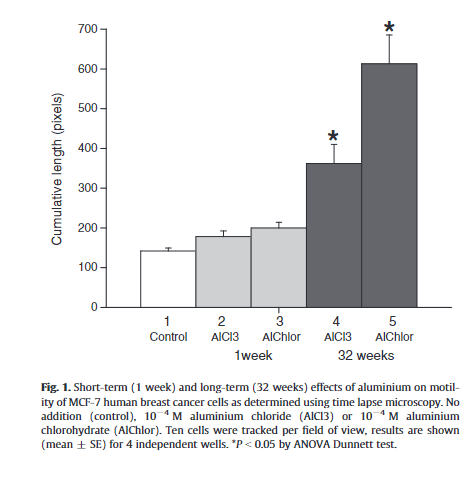
The higher the bars are, the further distance breast cancer cells travelled under a time lapse microscope.
You can see that with aluminum, (2-5), these breast cancer cells crawled/moved freaking far, more than five times the distance of cancer cells without aluminum (1, control).

If someone asks “do we know exactly how much harm aluminum in antiperspirants inflicts?”
The answer is we don’t know exactly how much yet.
But if someone asks “is there scientific evidence that aluminum can affect cancer?
The answer is YES, 100%, and next time you can tell them how it can help cancer cells walk farther.
Paper discussed today:
Darbre, et al. Effect of aluminium on migratory and invasive properties of MCF-7 human breast cancer cells in culture,
Journal of Inorganic Biochemistry, Volume 128, 2013, Pages 245-249.
*”Primary scientific literature” means these authors actually conducted experiments in a laboratory themselves, unlike “review articles,” the other type of articles that I tend to hate, because most often review articles are just collection of “other people said so” without authors actually conducting any experiment themselves. And oftentimes review article authors just do a cursory reading of other people’s primary literature to make such summaries, and they become legitimate-looking but misinformation-spreading monsters.
 FreshCult
Leave a comment